
Building an ATU-100 Automatic Antenna Tuner (N7DDC Design)
Automatic antenna tuners are one of those pieces of equipment that quickly become indispensable, particularly if you enjoy experimenting with antennas or operating portable.
Today, I completed the build of an ATU-100 antenna tuner based on the well-known N7DDC design, using the mini/extended board variant published by Dfinitski.
Why the ATU-100?
The ATU-100 has earned a solid reputation within the amateur radio community. It is a compact, relay-based automatic tuner capable of matching a wide range of antennas across the HF bands, and it works particularly well with end-fed and random-wire antennas.
What makes this design especially attractive is that it is:
- Open and well documented
- Widely supported by the amateur radio community
- Highly configurable in both hardware and firmware
- Suitable for fixed, portable, and QRP operation
Kit and Hardware Choices
For this build, I purchased a pre-packaged ATU-100 PCB kit from Amazon and sourced the remaining hardware separately. This approach gave me some flexibility when it came to enclosure layout and component selection.
One deliberate upgrade was opting for a larger OLED display rather than the smaller default screen. This has proven to be a worthwhile improvement, particularly for readability when operating portable or in less-than-ideal lighting conditions.
The larger display provides:
- Clearer SWR and forward/reflected power readouts
- Better visibility of tuning status and operating mode
- Improved usability without adding complexity to the build
Assembly Experience
Assembly was straightforward and well within the capability of anyone comfortable with basic through-hole soldering.
A few observations from the build process:
- Component placement on the PCB is logical and clearly labelled
- Relay alignment benefits from taking time and checking fit before soldering
- No specialist tools were required beyond a temperature-controlled soldering iron
- Firmware flashing was simple, aided by good documentation and community support
Overall build time was reasonable, and the project was enjoyable throughout. It is the kind of build that rewards careful work rather than rushing.
First Impressions and Operation
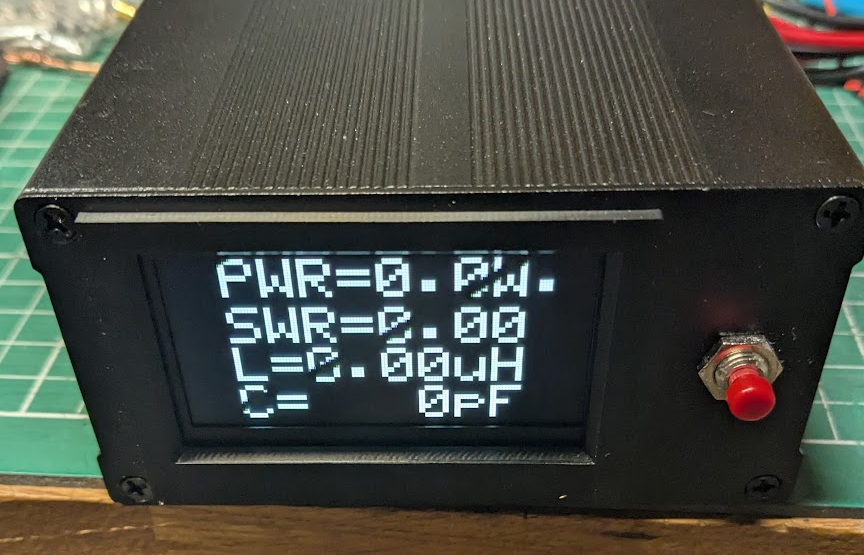
Once powered up, the tuner behaved exactly as expected:
- The OLED display initialized cleanly (picture shown caught the refresh)
- Menu navigation was intuitive
- Tuning cycles were fast and decisive
Paired with several antennas, the ATU-100 was able to achieve good matches quickly, even on antennas that were far from resonant. Relay noise is noticeable during tuning, but this is entirely expected and not intrusive.
This tuner is particularly well suited to:
- End-fed half-wave antennas
- Random wire antennas
- Portable and field operation
- Shack experimentation with non-resonant antennas
Technical Overview (to be tested)
ATU-100 (N7DDC) – Key Specifications
Frequency Range:
Typically 1.8–54 MHz (HF + 6 m), dependent on firmware and component selectionMatching Range:
Approx. SWR up to 10:1 (often better with suitable antenna lengths)Power Handling:
- ~20–25 W continuous (QRP-focused builds)
- Up to 100 W PEP with appropriate relays, capacitors, inductors, and cooling
(Always dependent on component quality and duty cycle)
Matching Network:
Relay-switched L-network with multiple inductance and capacitance combinationsRelays:
Typically Songle SRD-series or equivalent- 10 A contacts (model dependent)
- Mechanical relay switching (audible during tuning)
Controller:
Arduino Nano / ATmega328P-based controllerDisplay:
OLED (SSD1306-compatible)
Larger OLED fitted in this build for improved readabilityMeasurement:
Directional coupler for forward and reflected power measurement
Final Thoughts
Building the ATU-100 was a very satisfying project. It offers an excellent balance between cost, capability, and flexibility, and the option to customise elements such as the display makes it easy to tailor the tuner to your operating style.
If you enjoy building your own equipment and want a reliable, community-proven automatic antenna tuner, the N7DDC ATU-100 is well worth considering.
As with many amateur radio projects, half the value is in the learning — and this one delivers on both performance and experience.